
S

p

o

r

t

s

H

e

a

l

i

n

g

There are many variations of passages available sure there majority have suffered alteration in some form by inject humour or randomised words which don’t look even slightly believable.

Contact Info

Wellington Hospital, Wellington Knee Unit, Platinum Medical Centre, 15 - 17 Lodge Road, London, NW8 7JA

Knee Passport

The front brake and pulley of the knee

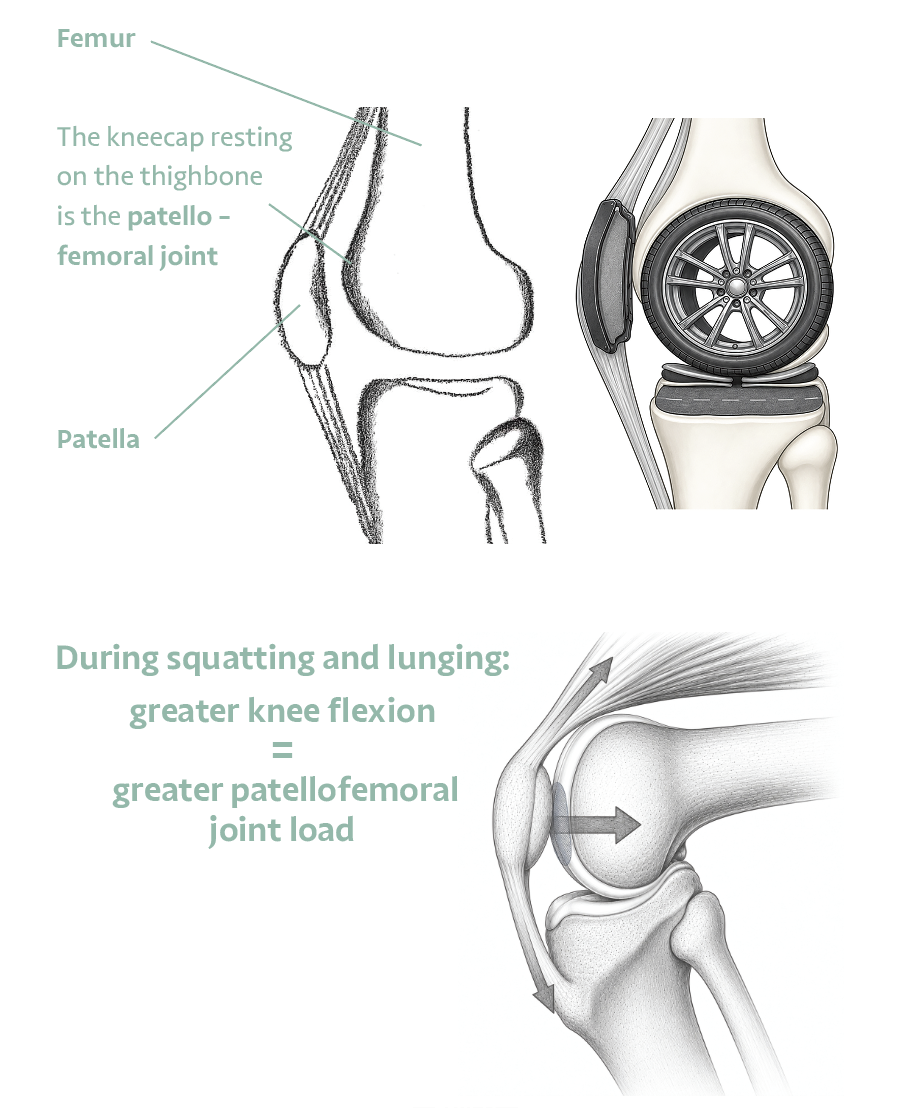
The patella rests in a groove on the femur. This joint transmits enormous forces during everyday activities and is one of the most common sources of knee pain — especially in active people.

HOW IT WORKS

The Patellofemoral Joint Under Load

The patellofemoral joint is formed where the kneecap meets the groove on the front of the thigh bone. As the knee bends, the patella tracks through this groove, guided by the balance of muscle forces around it — primarily the quadriceps and the structures on either side of the kneecap.

The load through this joint increases significantly with knee flexion. Walking generates approximately half body weight across the patellofemoral joint. Climbing stairs generates roughly three times body weight. A deep squat can generate forces of six to eight times body weight.

Pain in this joint often reflects how it is being loaded, not permanent damage. Muscle imbalance, repetitive impact, and previous injury are common contributing factors.


STAT HIGHLIGHTS

  • 0.5x — Body weight — walking
  • 3x — Body weight — stairs
  • 6–8x — Body weight — deep squat

‘Stand up slowly and evenly from a chair. Notice how the kneecap feels. This small act reveals a great deal about your patellofemoral joint.’

COMMON CAUSES OF PAIN

Why the Patellofemoral Joint Becomes Painful

COMMON CAUSES

  • Muscle imbalance — particularly weak VMO (inner quad)
  • Tight lateral structures pulling the patella off-track
  • Sudden increase in training load
  • Previous injury or surgery
  • Anatomical factors — groove depth, kneecap height, alignment

MANAGEMENT

  • Quadriceps strengthening — especially VMO
  • Hip and glute strengthening
  • Activity modification — reduce high-flexion loading
  • Taping or bracing for symptom relief
  • Gradual return to sport with load management
TRACKING & STABILITY

How the Kneecap Stays on Course

Most patellofemoral problems — whether pain or the unsettling sensation of the kneecap slipping — come back to a single idea: how well the kneecap tracks. As the knee bends and straightens, the kneecap should glide centrally down its groove. When that tracking is smooth, load is shared evenly across the joint; when the kneecap runs slightly off-centre, small areas are overloaded and the joint can feel painful or unstable.

A handful of anatomical features can make good tracking harder, and a clinician weighs them together rather than in isolation:

A shallow groove. Instead of a deep, well-defined V, the trochlear groove can be flat — giving the kneecap less of a channel to settle into. This is the single most common feature in kneecaps that slip.

A high-riding kneecap. If the patella sits a little high, it does not drop into and engage the groove until the knee has bent further, leaving it less contained through the early part of the movement.

An outward-angled pull. The kneecap tendon attaches to the shin at the tibial tubercle. If that point sits slightly to the outside, the overall pull on the kneecap is angled outward, nudging it toward the edge of its groove.

A tilt. The kneecap can sit tilted toward the outer side, concentrating load on its outer facet.


Holding against all of this is the medial patellofemoral ligament (MPFL) — a strong band on the inner side that works like a seatbelt, checking the kneecap from sliding outward. It is the structure most often torn when a kneecap dislocates. Working alongside it, the inner part of the quadriceps (the VMO) pulls the kneecap gently inward. Together they form the stability system that rehabilitation aims to strengthen and support.

Importantly, having one of these features is not the same as having a problem. Many people have a slightly high or shallow-grooved kneecap and never experience instability, because the surrounding structures compensate. Understanding which factors apply to your knee is what turns a worrying symptom into a clear, manageable plan.


‘Picture the kneecap settling into its groove like a carriage easing onto its rails as you bend the knee. Smooth, centred tracking is the goal — and much of it can be trained.’


YOUR SELF-CHECK: Descend a single step slowly, one leg at a time. Does your knee feel pain or does it drift inward? Both are signs of patellofemoral loading and hip/quad weakness that can be addressed with the right exercises.


REFERENCES — CLINICAL REFERENCES

  1. Crossley et al. (BJSM, 2016) — Patellofemoral pain consensus statement: exercise therapy is the most effective treatment.
  2. Witvrouw et al. (Am J Sports Med, 2000) — Prospective study linking quadriceps flexibility and strength to patellofemoral pain development.
  3. Dejour D, Zaffagnini S, Arendt EA, Sillanpää P, Dirisamer F (eds.) (2020) — Patellofemoral Pain, Instability, and Arthritis (2nd ed.). Springer. Source for the anatomical instability factors and trochlear dysplasia.
  4. LaPrade MD, Kennedy MI, Wijdicks CA, LaPrade RF (2015) — Anatomy and Biomechanics of the Medial Side of the Knee. Sports Med Arthrosc Rev. Source for MPFL and medial stabilisers.

Kneecap Assessment

Book a patellofemoral assessment with the SportsHealing team.