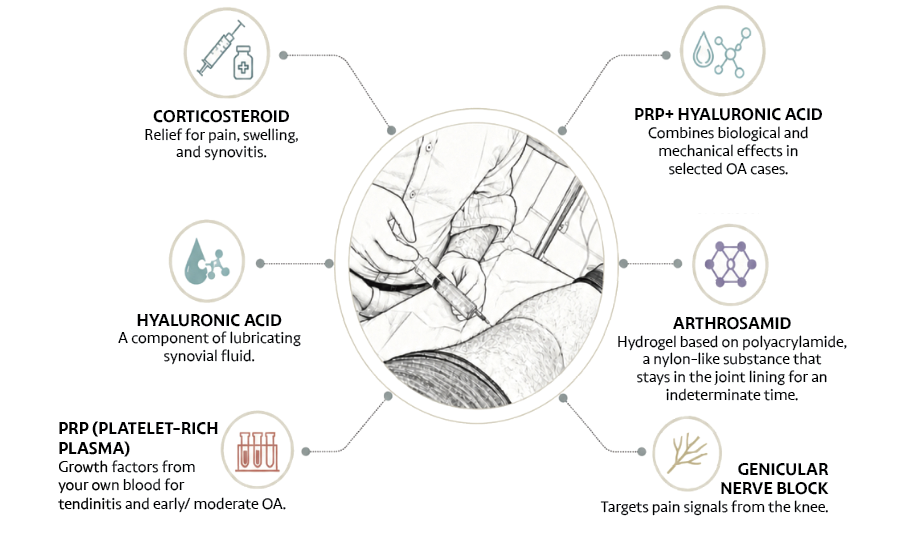
Knee injections aim to reduce pain, restore movement, and create the conditions for rehabilitation to work. They are not a substitute for strength and load management — but used well, they can make a meaningful short to medium term difference to those who respond to them.
THE OPTIONS
Types of Knee Injection
There are many different types of injections, all claiming different modes of action, each with their own risk profile. Efficacy and duration of relief varies for each person.
‘An injection aims to create a window of symptom relief in which the real work of recovery can begin. It does not cure the underlying problem.’
AT A GLANCE
Comparison
BEFORE CONSIDERING AN INJECTION: Ask your clinician: what is the injection intended to achieve, how will we know if it has worked, and what rehabilitation will follow it? An injection without a rehabilitation plan is a short-term measure, not a treatment.
REFERENCES — CLINICAL REFERENCES
- Bannuru et al. (Annals of Internal Medicine, 2015) — Comparative effectiveness of pharmacological interventions for knee OA: corticosteroid and hyaluronic acid evidence review.
- Shen et al. (American Journal of Sports Medicine, 2017) — PRP for knee OA: systematic review and meta-analysis.
- NICE Guidelines NG226 (2022) — Intra-articular injections: position within the OA management pathway