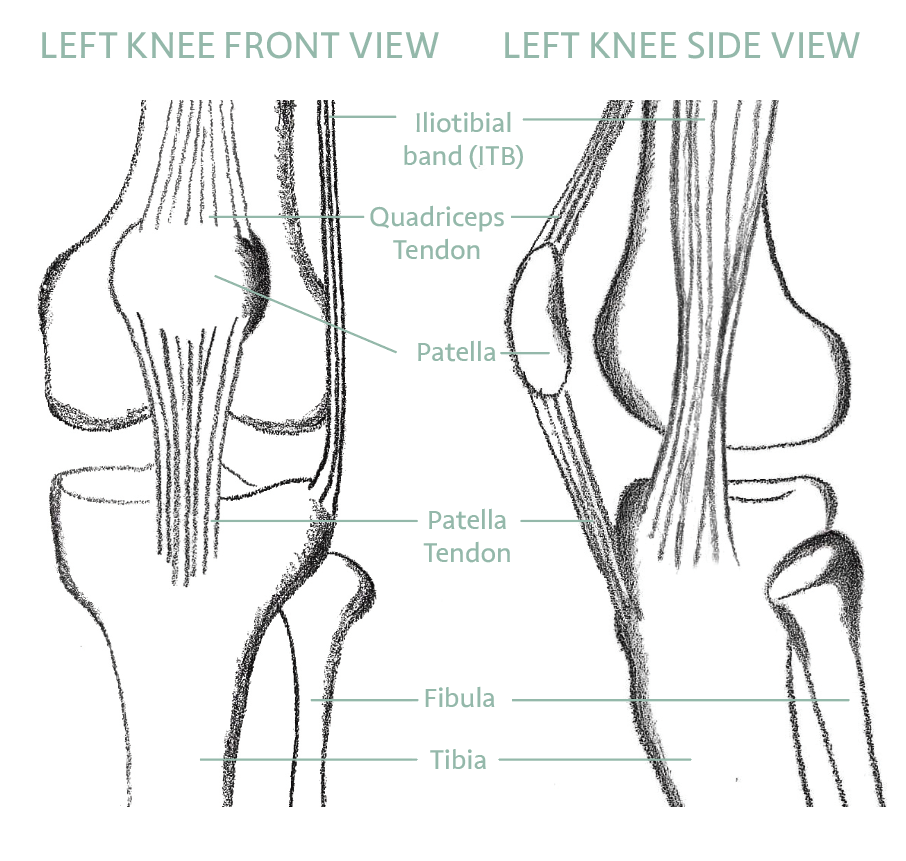
Tendons connect muscle to bone and transmit the forces generated by contraction. The tendons around the knee are among the most heavily loaded in the body — and they respond best to progressive, graduated loading.
THE TENDONS
Understanding the Knee Tendons
Quadriceps tendon — Connects the four quadriceps muscles to the top of the patella. This is the most powerful tendon at the knee and is responsible for the final force of knee straightening.
Patellar tendon — Connects the bottom of the patella to the tibia. Together with the quadriceps tendon, it forms the extensor mechanism — the system that straightens the knee. Pain at the lower pole of the patella or just below is common in jumping athletes and is called patellar tendinopathy.
Iliotibial band (ITB) — A thick band of connective tissue running down the outside of the thigh and knee. It can rub on the lateral femoral condyle and cause outer knee pain, particularly in runners and cyclists. This is called ITB syndrome.
‘For muscles and tendons, strong and stretched is better than strong and tight. Load your tendons gradually and build up duration and intensity of exercise.’
SIGNS OF TENDON PROBLEMS
- Pain at the start of activity that warms up
- Pain after prolonged sitting — “theatre sign”
- Tenderness directly on the tendon
- Pain that increases with load (jumping, squatting)
- Stiffness first thing in the morning
TENDON REHABILITATION PRINCIPLES
- Tendons need load — rest alone does not heal them
- Isometric exercises first — sustained holds reduce pain
- Progressive loading over weeks to months
- Avoid complete rest — maintain circulation
- Strong and stretched is the goal
YOUR SELF-CHECK: Press your fingertip just below the kneecap on the patellar tendon. Is there tenderness? Now try a single-leg squat to 30 degrees. Pain here that warms up with activity is a classic sign of patellar tendinopathy.
REFERENCES — CLINICAL REFERENCES
- Cook & Purdam (BJSM, 2009) — The continuum model of tendon pathology. Foundational paper on why tendons need progressive load, not rest.
- Rio et al. (BJSM, 2015) — Isometric exercise reduces pain in patellar tendinopathy and has central pain-inhibiting effects