
S

p

o

r

t

s

H

e

a

l

i

n

g

There are many variations of passages available sure there majority have suffered alteration in some form by inject humour or randomised words which don’t look even slightly believable.

Contact Info

Wellington Hospital, Wellington Knee Unit, Platinum Medical Centre, 15 - 17 Lodge Road, London, NW8 7JA

Knee Passport

The guardian of rotation

The posterolateral corner is a complex group of structures at the back and outer knee that controls rotation and overall stability. Injuries here are often subtle, frequently missed, and — if unrecognised — commonly cause failure of ACL or PCL reconstruction.


ANATOMY

What the PLC Does

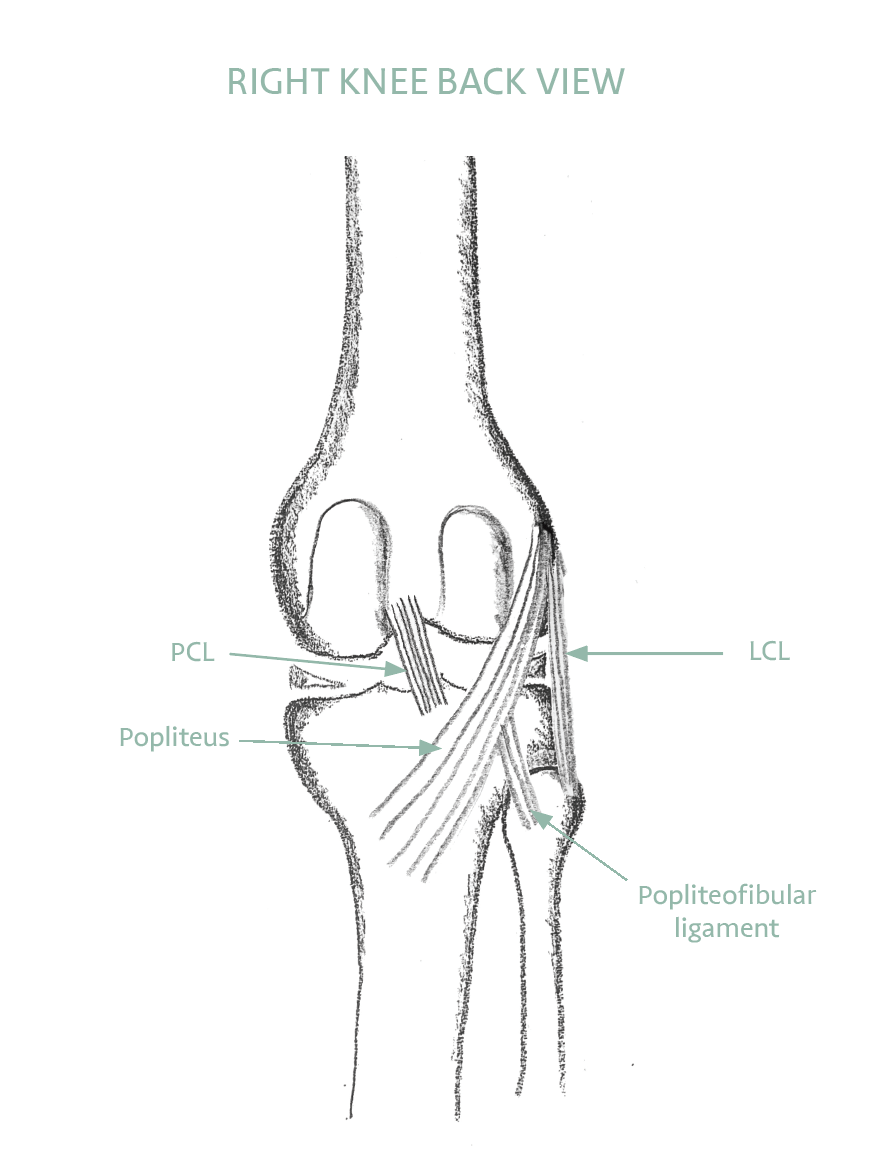
The posterolateral corner comprises several key structures: the lateral collateral ligament (LCL), the popliteus tendon, and the popliteofibular ligament, together with the posterior capsule and associated fibrous tissue. Working together, these resist external rotation of the tibia relative to the femur, and varus (outward bowing) forces on the knee.

This region was previously poorly understood and often referred to as the “dark side” of the knee — its anatomy was clarified largely through biomechanical research, including work from Mr Gupté’s group at Imperial College. A missed PLC injury is now recognised as one of the most common causes of ACL reconstruction failure.


HOW IT WORKS

Each Structure Has a Job

Although the posterolateral corner works as a unit, each structure has a defined role. The LCL is the primary restraint against the knee bowing outward. The popliteus tendon is the primary restraint against the shin rotating outward — the rotational control that gives this region its “guardian of rotation” name. The popliteofibular ligament backs both of them up, adding to rotational and outward-bowing control. Knowing which structure does what is what allows a surgeon to rebuild precisely what has been lost.

Because these structures are small, deep and overlapping, imaging alone can miss them — MRI is least reliable for the posterolateral corner, especially weeks or months after an injury. That is why a careful hands-on examination matters so much here. The dial test is the classic check: the clinician rotates the foot outward with the knee bent and compares the two sides. Extra outward rotation at 30 degrees of bend points to a posterolateral corner problem; extra rotation at both 30 and 90 degrees suggests the PCL is involved as well — another reason the corner and the PCL are always assessed together.


HOW PLC INJURIES HAPPEN

Mechanism and Associations

PLC injuries occur from direct varus force to the knee, hyperextension combined with varus stress, or high-energy trauma such as road accidents. They commonly occur alongside ACL or PCL tears in complex knee injuries. Isolated PLC injuries do occur but are less common.
The key clinical issue is that PLC injuries can be subtle — the initial examination may miss them, and the MRI interpretation requires specific knowledge of posterolateral anatomy. When a PLC injury co-exists with an ACL tear and is not identified, the persistent rotational instability will overload the ACL graft after reconstruction, leading to graft failure.


SIGNS OF PLC INJURY

  • Outer (lateral) knee pain and tenderness
  • A feeling of the knee giving way outward or into hyperextension
  • Difficulty walking downhill or on uneven ground
  • Instability during the stance phase of walking
  • Associated ACL or PCL injury — always examine the PLC
  • Abnormal external rotation on the dial test at 30° and/or 90°


‘It is especially important to detect PLC injuries when the ACL is also injured. A missed PLC injury is one of the most common causes of ACL graft failure.’

TREATMENT

Management and Surgery

Mild PLC injuries may respond to structured rehabilitation with quadriceps and hip strengthening, bracing, and controlled return to activity. However, significant PLC injuries — particularly those involving varus instability or hyperextension instability — typically require surgical reconstruction.

Surgery addresses the PLC structures and any co-existing cruciate ligament injuries. The correct sequencing of repairs matters: the PLC reconstruction should be performed in the same sitting as any ACL or PCL reconstruction, not as an afterthought. Mr Gupté’s expertise in complex multi-ligament knee surgery is directly relevant here.


NON-OPERATIVE

  • Mild injuries with no varus/hyperextension instability
  • Bracing and physiotherapy
  • Hip and quad strengthening
  • Careful monitoring for persistent instability

WHEN SURGERY IS NEEDED

  • Varus or hyperextension instability
  • Multiple ligament injuries — PLC with ACL or PCL
  • Failed conservative management
  • High-demand athlete

YOUR SELF-CHECK: Does your knee feel like it bows outward or gives way into hyperextension during walking or pivoting? Does the outer side of the knee feel unstable, particularly on uneven ground? These are PLC symptoms and need specialist assessment — particularly if you have an ACL injury, as the two injuries commonly co-exist.


MR GUPTÉ’S RESEARCH

Publications from the SportsHealing / Imperial Team

REFERENCES — GUPTE CM PUBLICATIONS — POSTEROLATERAL CORNER AND RELATED STRUCTURES

  1. Amis AA, Gupte CM, Bull AM, Edwards A (2006) — Anatomy of the posterior cruciate ligament and the meniscofemoral ligaments. Knee Surgery, Sports Traumatology, Arthroscopy 14(3):257–263. This detailed anatomical study from Imperial College, co-authored by Mr Gupté, is a frequently cited reference for understanding the PCL and posterolateral structures. It underpins surgical planning for PLC reconstruction.
  2. Kittl C, El-Daou H, Athwal KK, Gupte CM, Weiler A, Williams A, Amis AA (2016) — The role of the anterolateral structures and the ACL in controlling laxity of the intact and ACL-deficient knee. American Journal of Sports Medicine 44(2):345–354. Establishes the biomechanical hierarchy of the lateral and posterolateral structures — foundational for understanding what the PLC does and what happens when it fails.
  3. Gupte CM, Bull AMJ, Thomas RD, Amis AA (2003) — The meniscofemoral ligaments: secondary restraints to the posterior drawer. Journal of Bone and Joint Surgery Br 85(5):765–773. Shows how the posterolateral meniscofemoral structures assist the PCL in complex rotational stability — important context for multi-ligament injury involving the PLC.
  4. Gupte CM, Shaerf DA, Sandison A, Bull AMJ, Amis AA (2014) — Neural structures within human meniscofemoral ligaments. Anatomy Research International. The neural (proprioceptive) content of the posterolateral ligament complex is a key target for rehabilitation — this paper demonstrates its existence in adjacent structures.
  5. LaPrade RF, Ly TV, Wentorf FA, Engebretsen L (2003) — The posterolateral attachments of the knee: a qualitative and quantitative morphologic analysis. American Journal of Sports Medicine 31(6):854–860. Foundational anatomical description of the PLC (non-Gupte).
  6. Swinford ST, LaPrade R, Engebretsen L, Cohen M, Safran M (2020) — Biomechanics and physical examination of the posteromedial and posterolateral knee: state of the art. J ISAKOS. Source for the individual roles of the LCL, popliteus and popliteofibular ligament, and for the dial test.
  7. Stannard JP, Brown SL, Farber WJ et al. (2005) — The posterolateral corner of the knee: repair versus reconstruction. American Journal of Sports Medicine 33:881–888. Evidence that reconstruction provides superior outcomes to direct repair for significant PLC injuries.

Complex Knee Assessment

PLC injuries require specialist expertise in multi-ligament knee surgery. Book with Mr Gupté and the SportsHealing team.