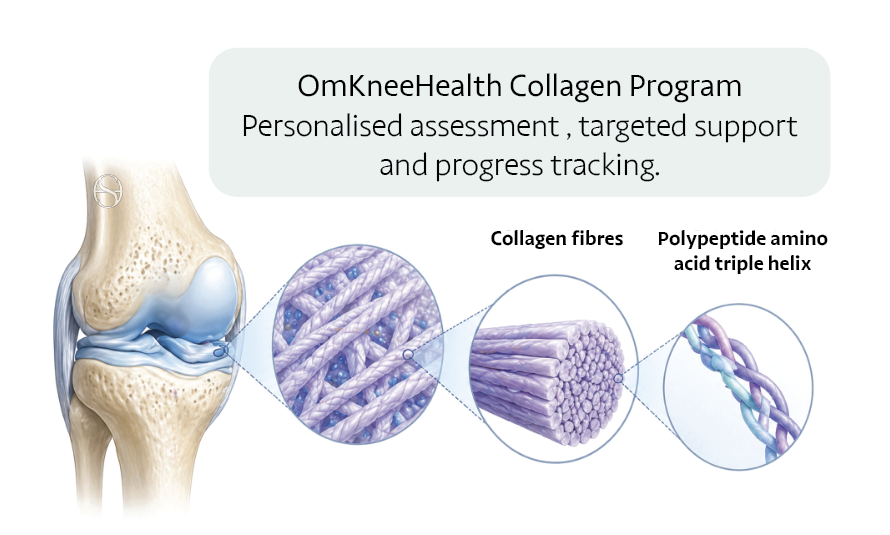
Collagen is the primary structural protein of the knee — forming cartilage, ligaments, tendons, and the meniscus. What you eat, how you sleep, and how you move all directly influence your collagen health.
WHY COLLAGEN MATTERS
The Architecture of Your Knee
Collagen makes up approximately 70% of cartilage dry weight and is the primary structural protein in ligaments, tendons, and the meniscus. It provides strength, shape, and resistance to load.
With age, collagen production slows and becomes less organised — reducing cartilage resilience, slowing repair, and increasing injury risk. Type II collagen is specific to chondral cartilage. Type I is found in bone, tendons, ligaments, and the meniscus.
Collagen adapts to load. Appropriate exercise strengthens collagen-rich tissues, improves resilience, and supports long-term knee health.
‘Think of collagen as the scaffold that holds your knee together. Your actions — what you eat, how you sleep, how you move — can influence your collagen health every day.’
HOW TO SUPPORT COLLAGEN
Make Sure Your Diet and Supplements Include
NUTRITION
- Vitamin C — essential cofactor for collagen synthesis; citrus, peppers, leafy greens
- Protein — provides the amino acids for repair and adaptation
- Collagen Peptides — support joint and tendon health with appropriate loading
- Zinc and Copper — support cross-linking and structural integrity
LIFESTYLE
- Sleep — deep sleep drives repair and collagen renewal
- Avoid Smoking — directly degrades collagen fibres and delays healing
- Movement — collagen adapts to load; appropriate exercise is essential
- Reduce Sugar — advanced glycation products damage collagen structure
YOUR SELF-CHECK: Are you eating enough protein? A simple target is 1.2 to 1.6 grams of protein per kilogram of body weight per day for active adults. Protein is the building block for collagen — and most people underestimate how much they need.
REFERENCES — CLINICAL REFERENCES
- Shaw et al. (American Journal of Clinical Nutrition, 2017) — Vitamin C supplementation before exercise increases collagen synthesis in tendon tissue.
- Zdzieblik et al. (Nutrients, 2021) — Specific collagen peptides improve knee joint discomfort in young adults during physical activity.
- Shoulders & Raines (Annual Review of Biochemistry, 2009) — Collagen structure and stability: foundational review of the triple helix and cross-linking.